
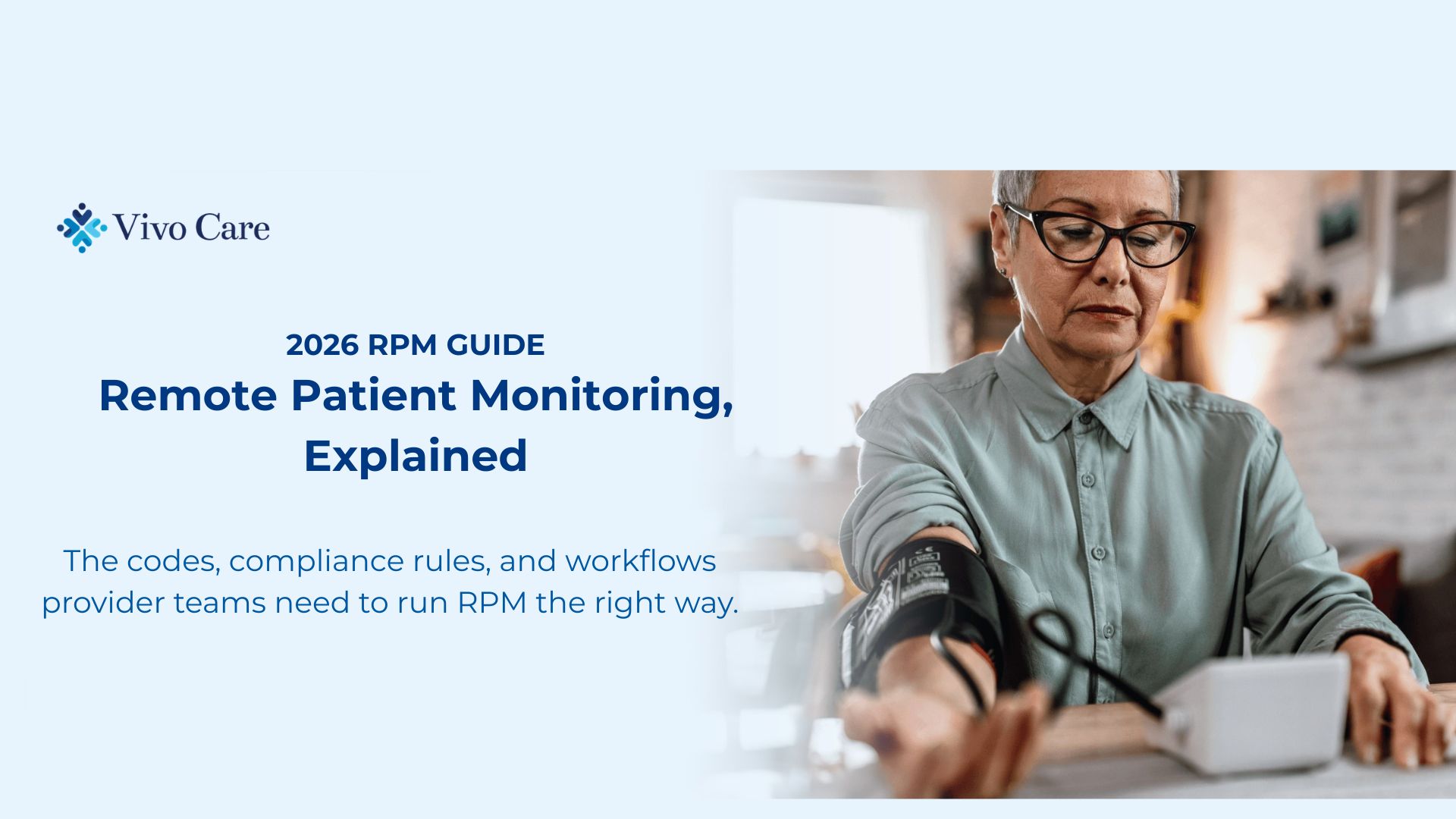
The 2026 Remote Patient Monitoring Guide
Medically reviewed by Dr. Aamir Iqbal, MD, Vivo Care Medical Director. Last updated June 2026.
Remote patient monitoring (RPM) lets a care team track a patient’s physiologic data, such as blood pressure, glucose, or weight, between office visits, and then act on it. In 2026, the Centers for Medicare & Medicaid Services (CMS) reshaped the rules: new shorter-duration codes, reimbursement that begins at two days of data instead of sixteen, and tighter expectations for documentation and clinical response. This guide covers what RPM requires in 2026, who qualifies, the current CPT codes and rates, how a compliant program runs day to day, and what the clinical evidence shows. It is written for providers and operations leaders standing up or tightening a remote patient monitoring program.
Prefer to read it offline?
Download the full 2026 RPM guide as a PDF, the clinical bar, the codes, and the operating model in one document.
Download the 2026 RPM Guide (PDF) →What RPM is, and what changed for 2026
RPM is a Medicare-covered service in which patients use a U.S. Food and Drug Administration-cleared device at home to capture a physiologic reading, which transmits to their care team for review and treatment management between visits. A working program rests on four pieces working together.
- Connected devices. Cellular or paired hardware the patient can use without a technical setup.
- Software. A remote care platform that collects the data, flags what matters, and holds the billing-ready audit trail.
- Licensed clinical staff. People responsible for monitoring, outreach, and the documentation that keeps the program compliant.
- Defined workflows. Clear rules for monitoring, escalation, and documentation so the program runs the same way every time.
What changed for 2026 is the bar. New codes reward shorter, more responsive monitoring, and the rules expect a real clinical response, not passive data collection. The provider stays the decision-maker throughout. RPM supplies the data and the clinical labor between visits.
Who qualifies for RPM, and who doesn’t
RPM is billed for a patient with an acute or chronic condition who has an established relationship with the billing practitioner and a documented clinical reason to be monitored. It is not limited to specific diagnoses or specialties, and it commonly supports patients managing hypertension, diabetes, weight, and other chronic conditions.
The boundary matters. Patients with no prior relationship to the practitioner, a clear individualized reason to monitor that has not been documented, or no established clinical need are not appropriate candidates. A blank enrollment program, signing patients on without an individualized rationale, is exactly what audits look for.
“Rather than doing a one size fits all, we really look at our patients and tailor which programs would they benefit from.”
Dr. Aamir Iqbal, Medical Director, Vivo Care, and Practicing Primary Care Physician
The 2026 RPM CPT codes and rates
The 2026 code set covers setup, device supply and data transmission, and treatment management, with new short-duration codes added for 2026. The rates below are CMS national non-facility amounts and vary by locality. For the full picture, see the 2026 Remote Care Billing and Coding Guide and our breakdown of the new RPM codes 99445 and 99470.
| Code | What it covers | Threshold | 2026 rate | vs 2025 |
|---|---|---|---|---|
| 99453 | Initial device setup and patient education | One-time, per episode of care | $21.71 | +10.1% |
| 99445 / 99454 | Device supply and data transmission (2 or more days of readings) | 99445: 2 to 15 days. 99454: 16 to 30 days. Mutually exclusive per patient per 30-day period. | $52.10 | New / +21.1% |
| 99470 | Treatment and management, first 10 to 19 minutes | New for 2026. Requires one live interactive contact. Exclusive with 99457 and 99458. | $26.05 | New |
| 99457 | Treatment and management, first 20 minutes | 20 or more minutes. Requires one live interactive contact. | $51.77 | +8.2% |
| 99458 | Treatment and management, each additional 20 minutes | Add-on to 99457 only. | $41.41 | +7.7% |
Rate basis: CMS 2026 Physician Fee Schedule, national non-facility, GPCI 1.0. Actual reimbursement varies by locality, Medicare Administrative Contractor, and payer.
Read the table this way
Three services stack into a monthly RPM claim: a one-time setup (99453), a single device-supply code (99445 or 99454), and one treatment-management code (99470 or 99457, with 99458 as the add-on). The billing rules below keep those from being double-counted.
Billing mechanics: the three rules that changed in 2026
The 2026 changes are not cosmetic. They move where revenue starts and how treatment time is counted.
- Device data now bills at 2 days, not 16. With 99445, a patient who records readings on 2 to 15 days in a 30-day period generates a billable device-supply claim. Reimbursement no longer waits for 16 days of data.
- Treatment management has a new shorter tier. The new 10 to 19 minute code (99470) sits below the 20-minute 99457, so shorter months of active management are still reimbursable. Each requires at least one live, interactive contact with the patient.
- Live interactive contact is non-negotiable. A treatment-management code cannot be billed on passive data alone. There must be a real, two-way contact, and an asynchronous message does not count.
How an RPM program runs in practice
A working program moves a patient through eligibility, consent, device setup, daily data capture, clinical monitoring and outreach, and documented treatment management, with the provider supervising and the care team running the day-to-day work.
- 1. Verify eligibility. Confirm an established relationship, a clinical reason to monitor, and benefit eligibility.
- 2. Document consent. Capture the patient’s consent, including cost-sharing responsibility.
- 3. Set up and educate. Get the device into the patient’s hands and confirm they can use it.
- 4. Capture readings. Readings transmit automatically from home, with no app or sync to manage.
- 5. Monitor and reach out. Care navigators review readings, flag changes, and run the interactive outreach codes require.
- 6. Document escalation. Record time, contacts, and decisions, and document escalation to the provider.
“We do the work in between visits.”
Kat Baker, RN, Director of Clinical Operations, Vivo Care
What an RPM program runs on
An RPM program runs on two pieces of technology: the connected devices in the patient’s home, and the platform the clinical team works in. For most patient populations, cellular-enabled devices that connect to the nearest mobile network automatically, with no WiFi, smartphone, or app, are what make the program viable in rural and low-bandwidth settings.
The platform is where the program holds together. Getting one reading into the chart is easy. Managing a whole panel against clinical thresholds every month is not, and that is what the software exists for. It ingests daily readings, triages them by urgency, tracks the interactive time each billing code requires, holds the audit trail, and flags which patients are about to fall below the billing floor. The value is in the triage, not the device. Raw data at panel scale causes alert fatigue. A capable platform is what lets a clinical team monitor a large panel without the program quietly degrading the first time the clinic gets busy.
Where RPM goes wrong, and what auditors look for
Federal scrutiny has intensified as spending crossed half a billion dollars. The most common failure points are enrolling patients with no clinical rationale or active relationship, billing management time without the required live contact, and weak documentation of setup and clinical necessity. In a September 2024 review, the Office of Inspector General (OIG) found that of more than $500 million in Medicare RPM payments in 2024, roughly 43% of enrollees did not receive all three components of the service: device supply, data transmission, and treatment management. For more, see our overview of increased OIG scrutiny on RPM.
What auditors look for is specific: a documented initiating visit and established relationship, an individualized clinical rationale, complete time logs and at least one live interactive contact per management code, clear separation of RPM time from other code time, and documented patient consent. A defensible RPM program is built on documentation discipline, and every code billed should trace to an artifact an auditor can see.
Run RPM in-house, or with a partner?
The decision comes down to four things: clinical staffing, technology, compliance capacity, and time to a working program. Most practices underestimate the ongoing clinical monitoring load more than any other factor.
| Self-managed | Managed Clinical | |
|---|---|---|
| Who monitors | Your own clinical staff, on the Vivo Care platform | Vivo Care licensed care navigators, as an extension of your team |
| Staying current with CMS | You track CMS coding and rule changes each year | Vivo Care tracks CMS changes and keeps the program compliant for you |
| The tradeoff | More control, more internal load | Provider supervises and retains medical decision-making, without the staffing load |
Many practices run RPM alongside Chronic Care Management (CCM), billed concurrently when each program’s requirements are independently met. If staffing is the constraint, managed RPM services let a practice run a complete program without hiring a monitoring team.
Want your program checked against the 2026 requirements?
A Vivo Care specialist will walk through eligibility, workflow, and compliance for your practice.
Book a free consult →What the clinical evidence shows
The peer-reviewed evidence is consistent on one point: RPM improves outcomes when the data drives an active clinical response, and does little when it does not. The common thread across the strongest results is not the device, it is the team responding to the data. For the full picture, see our review of the clinical evidence supporting RPM.
- Active monitoring works. In the HYPERLINK trial (JAMA), structured home blood-pressure monitoring with pharmacist-led management achieved blood-pressure control far above usual care. In TIM-HF2 (The Lancet), structured RPM with 24/7 telemedical support reduced days lost to unplanned cardiovascular hospitalization and all-cause death.
- Passive monitoring did not. When monitoring was passive, a connected cuff with no clinical response loop, or an automated phone check-in, outcomes matched usual care. RPM is only as effective as the clinical workflow behind it.
Vivo Care’s own monitored population shows the same pattern. Within three months of enrollment, goal-range systolic readings increased from 31.4% to 38.9%, high-critical systolic readings decreased from 13.2% to 10.1%, and diastolic readings in goal range rose from 61.7% to 66.3% across the network. Active RPM participants average 545 days (about 17.6 months) of continuous enrollment, and 96.9% of monitored patients meet the CMS billing threshold (Vivo Care network, year to date 2026).
Frequently Asked Questions
What are the requirements to bill each RPM code?
RPM covers setup and education (99453), device supply and data transmission (99445 for 2 to 15 days, or 99454 for 16 to 30 days), and treatment management (99470 for 10 to 19 minutes, or 99457 for 20 minutes, with 99458 as the additional-time add-on). Each management code requires at least one live, interactive contact with the patient, and the time must be documented.
How many days of readings does RPM require?
For 2026, a patient who records readings on 2 to 15 days in a 30-day period supports a billable device-supply claim under 99445. The previous 16-day minimum still applies to 99454. This is the change that lets reimbursement begin earlier in a monitoring month.
Can RPM and CCM be billed together for the same patient?
Yes. RPM can be billed concurrently with Chronic Care Management (CCM) when each program’s requirements are independently met and the time counted for one is not counted toward the other. Many practices run the two together to support patients between visits.
Does the patient need home internet or WiFi?
No. Cellular-enabled devices connect to the nearest mobile network automatically and need no home internet, WiFi, or smartphone. The patient takes a reading and it transmits on its own, which is what makes RPM workable in rural and low-bandwidth settings.
Who can perform RPM monitoring?
RPM can be furnished by clinical staff under the general supervision of the billing practitioner. With a Managed Clinical model, U.S.-based, state-licensed care navigators handle the monitoring and outreach as an extension of the provider team, while the provider supervises and retains medical decision-making.
Sources and medical review
This guide reflects the 2026 CMS Physician Fee Schedule and peer-reviewed clinical research, including the HYPERLINK trial (JAMA), TIM-HF2 (The Lancet), the OIG’s September 2024 review of Medicare RPM payments, and the CMS 2026 final rule. Vivo Care network figures are drawn from the company’s monitored population, year to date 2026.
Medically reviewed by
Dr. Aamir Iqbal, MD
Medical Director and internal-medicine physician. Dr. Iqbal reviewed this guide for clinical accuracy across eligibility, coding, billing mechanics, and the clinical-evidence summary.
Related reading
- 2026 Remote Care Billing and Coding Guide
- CMS 2026: New RPM codes 99445 and 99470
- Remote Patient Monitoring overview
- Chronic Care Management
Talk through your program
Download the full guide, or book a free consult and a Vivo Care specialist will check your program against the 2026 requirements.